It's the 2nd of the month. Your accounts team has 40 conveyance sheets on the desk: kilometres written by hand, a few petrol bills, and a list of client names. One salesman claims 74 km for a day when he visited three clients in the same part of the city. You suspect it's padded, but you can't prove it. So you either pay it and resent it, or cut it and start an argument.
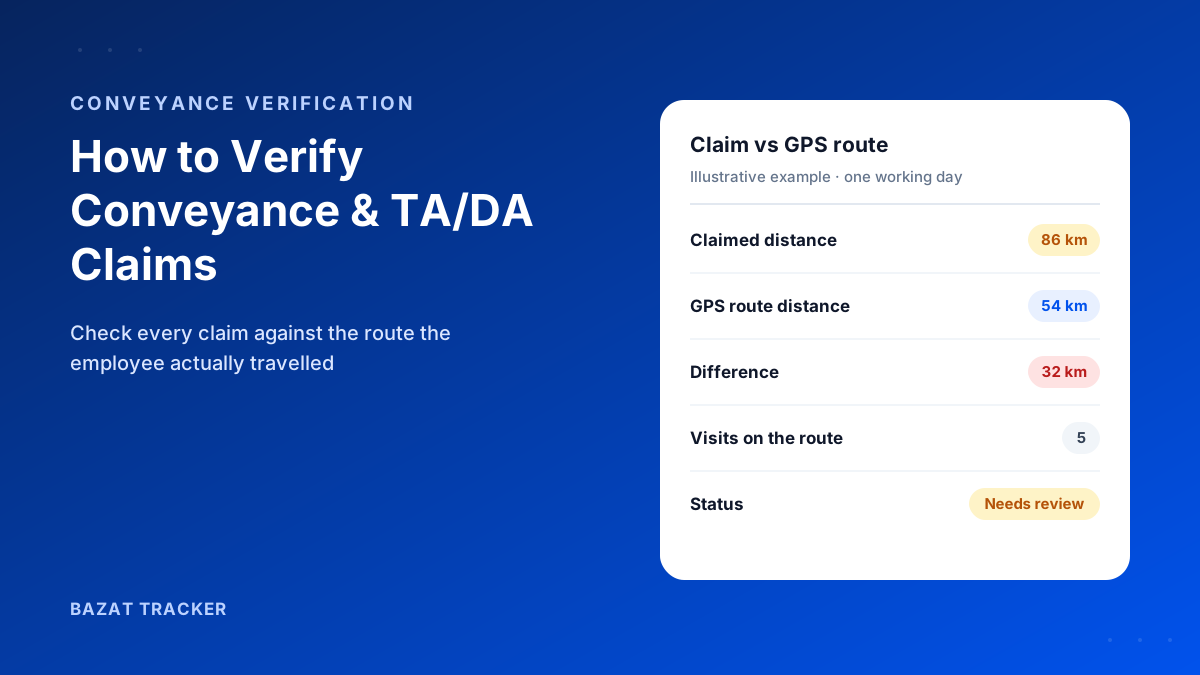
You verify a conveyance or TA/DA claim by comparing the kilometres claimed against the route the employee actually travelled that day. A field tracking app records each employee's route and distance during working hours, so the claim can be checked against the recorded distance before approval. Set a clear tolerance (for example, 10% above recorded distance), and anything outside it gets a question instead of an automatic payment.
Why is this so hard today?
Because the only evidence most companies have is the claim itself. The employee writes the distance, maybe attaches a fuel bill, and the manager signs it. Nobody has an independent record of where the employee went, so there's nothing to check the claim against.
How Conveyance Claims Get Padded
Most padding isn't dramatic fraud. It's small, regular and easy to justify, which is exactly why it adds up.
The common patterns
- 1Rounding up every day: 32 km becomes 40 km, every working day of the month.
- 2Claiming a visit that was done by phone, along with the travel to it.
- 3Claiming a longer route than the one actually taken between two clients.
- 4Claiming personal travel, such as the trip home for lunch, as work travel.
- 5Fuel bills from a family vehicle or a weekend trip attached to a weekday claim.
Here's the real cost.
A few extra kilometres per person per day looks trivial. Multiply it by every field employee and every working day, and it becomes a meaningful monthly expense, paid for distance nobody travelled. Worse, the honest employees see it happening and stop believing the system is fair.
The Manual Checks (and Why They Don't Scale)
Some managers try to check claims with Google Maps: take the list of clients, plot the route, and compare. It works for one claim. It doesn't work for 40 claims a month, because nobody has the time, and the client list itself is self-reported. If the visit didn't happen, the map check just validates a fictional route.
Fixed allowances are the other workaround: pay everyone a flat monthly conveyance. It stops the arguments, but it overpays people with short routes and underpays the ones who genuinely travel the most, who are usually your best field staff.
How to Verify Claims Against the Actual Route
The fix is an independent record of travel. A field tracking app like Bazat Tracker records each employee's location during shift hours, builds the day's route with stops, and calculates the distance travelled. When the employee submits a conveyance claim in the app, the manager sees the claimed kilometres next to the recorded route and distance.
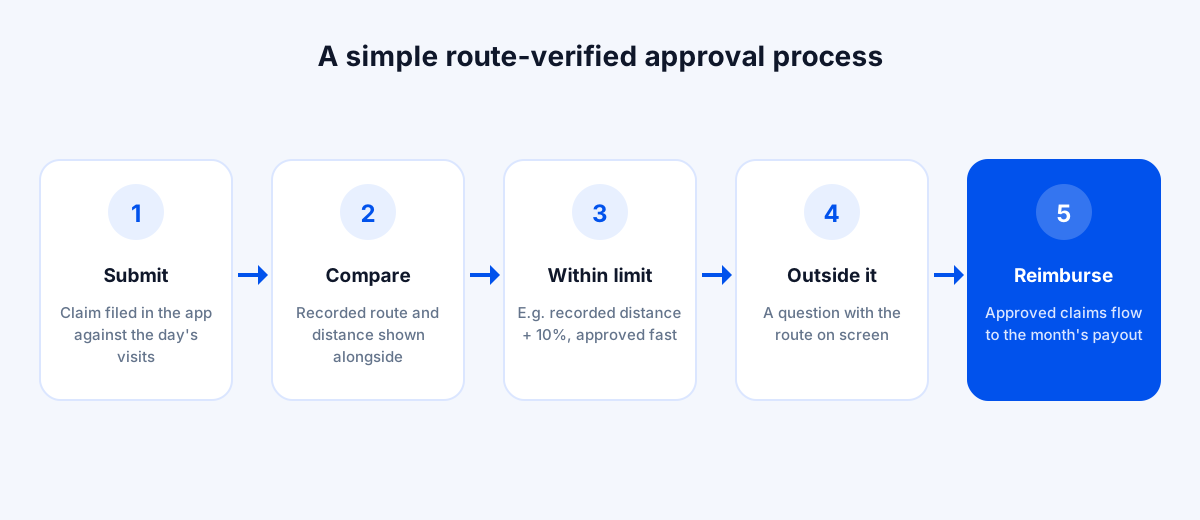
A simple approval process
- 1Employees submit conveyance and expense claims from the app, attached to the date and the visits made.
- 2The app shows the recorded distance and route for that day alongside the claim.
- 3Claims within your tolerance (for example, recorded distance plus 10%) are approved quickly.
- 4Claims outside it get a question, with the route on screen, not an accusation.
- 5Approved claims flow into the month's reimbursement, so accounts doesn't re-type anything.
What about GPS gaps?
Highways, basements and rural roads lose signal. Good apps store location on the phone while offline and sync it later, so the route fills in. Allowing a tolerance also covers small differences between recorded GPS distance and the vehicle's odometer.
Paper Conveyance Sheets vs. Route-Verified Claims
| Manual Process | Bazat Tracker | |
|---|---|---|
| Evidence for the claim | Manual ProcessThe employee's own figure and a fuel bill | Bazat TrackerThe route and distance recorded during shift hours |
| Time to check 40 claims | Manual ProcessHours of map plotting, or no check at all | Bazat TrackerMinutes: claim and recorded distance side by side |
| Padded kilometres | Manual ProcessUsually paid, because they can't be disproved | Bazat TrackerVisible immediately, outside the tolerance |
| Disputes | Manual ProcessManager's suspicion vs employee's word | Bazat TrackerBoth look at the same recorded route |
Set Fair Conveyance Rules First
Verification works best when the rules are written down before anyone is checked. Decide the rate per km by vehicle type, whether travel from home to the first visit counts, how personal stops are treated, and the tolerance above recorded distance you'll accept without questions. Share the policy with the team, then switch on verification.
And introduce it the right way.
Position it as protection for honest employees: claims get approved faster, nobody has to argue about their kilometres, and the people who genuinely travel the most get paid for it. Track only during working hours, so personal time stays private. Under India's DPDP Act, being clear about what is collected and why is also what the law expects.
Bazat Tracker includes route history, expense and conveyance claims, and payroll on every plan, from ₹249 per user per month on yearly billing, with a 3-day free trial.