Your site supervisor's register shows 22 labourers present. A surprise visit at 11 AM finds 17. Nobody is lying exactly: five people were “just coming”. But the register already says they were there at 9, and that's what payroll will pay for.
Proxy attendance is when one employee marks another as present, by signing a register, punching a shared card or PIN, or using a colleague's phone. You reduce it sharply by making attendance depend on two things the absent person can't hand over: their face (verified with a liveness check so a photo doesn't work) and their location (a punch accepted only inside the site or office geofence). Add fake-GPS detection, and remote proxy punches become far harder too. No system removes attendance fraud entirely, but these checks close the common methods.
What Proxy Attendance Looks Like in Different Workplaces
Common scenarios
- 1Construction sites: a gang supervisor or contractor marks absent labourers present in the muster roll, and the contractor bills for them.
- 2Security agencies: a relief guard is shown on duty at a client post, but the rostered guard never came and nobody replaced him.
- 3Field sales: a salesman punches in from home with a mock-location app, so his day appears to start at the first client.
- 4Offices and factories: one employee swipes two or three ID cards, or shares a PIN, at the entry terminal.
The 6 Most Common Proxy Attendance Methods
1. The register signature.
A supervisor or colleague signs the muster roll for someone who hasn't arrived. It's the oldest method and the hardest to catch, because the register itself is the only evidence.
2. The shared PIN or card.
Card swipes and PIN-based attendance prove that a card or PIN was used, not who used it. Handing a card to a colleague takes two seconds.
3. Carrying a colleague's phone.
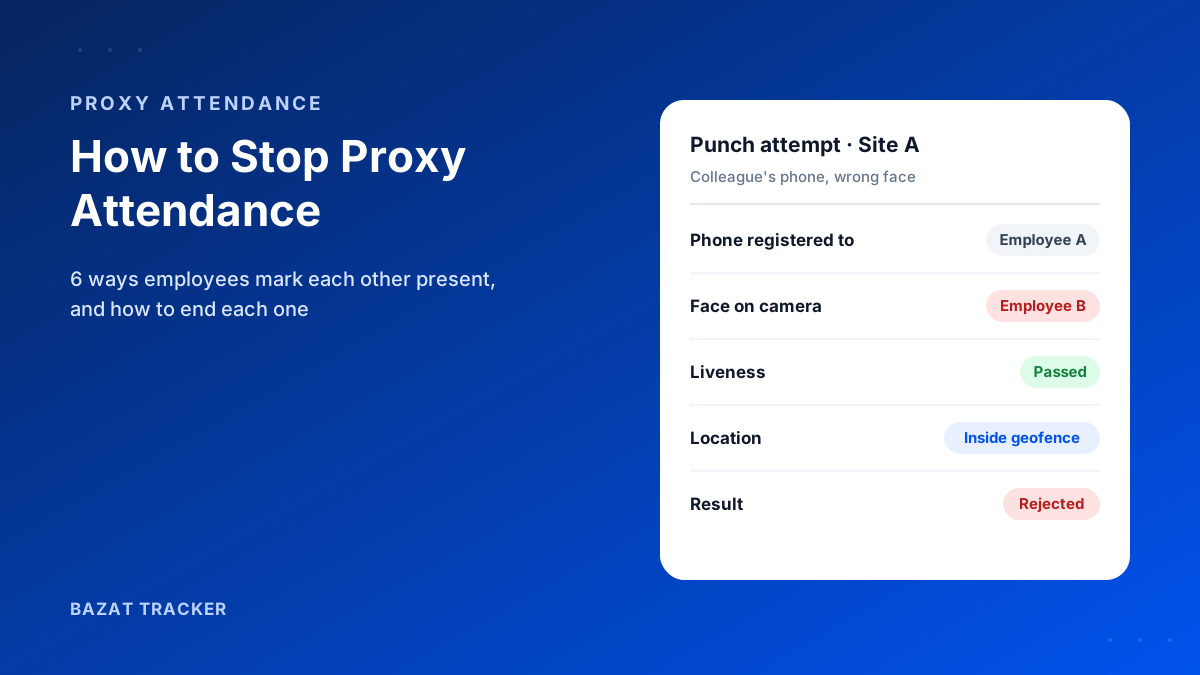
With GPS-only mobile attendance, one employee can carry two or three phones to the site and punch in for everyone. The location is genuine; the people aren't.
4. A selfie from a photo.
Selfie attendance without a liveness check can be passed with a photo of a photo, or a picture on another phone's screen.
5. Fake GPS from home.
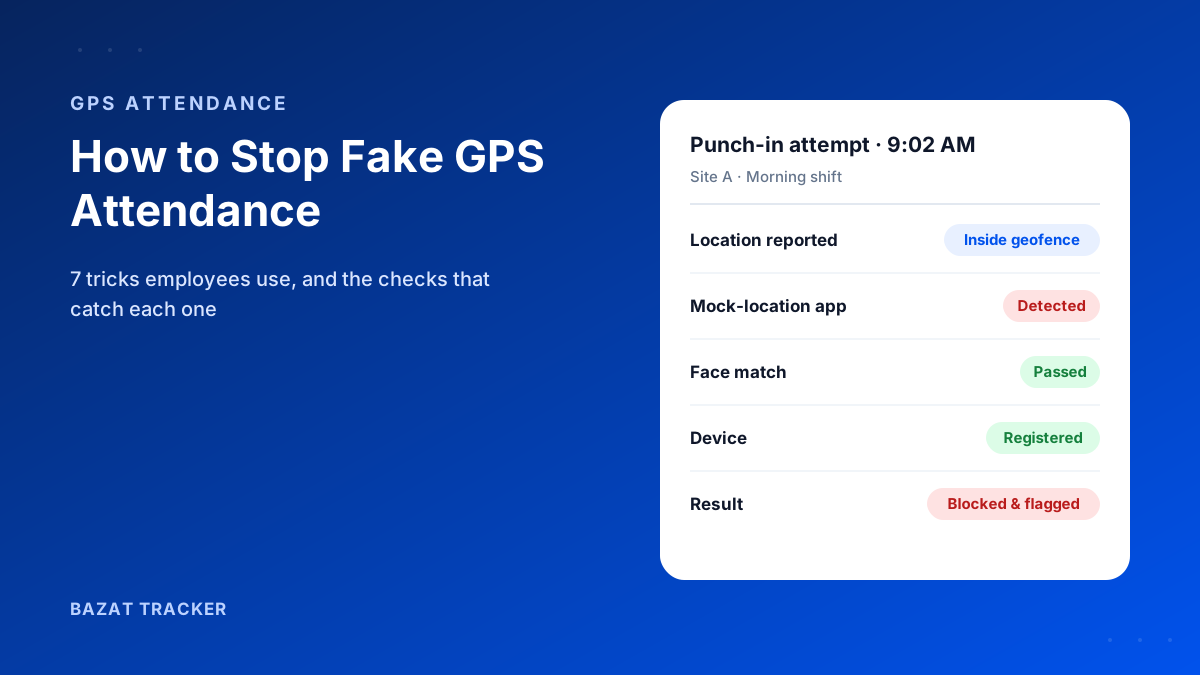
Mock-location apps on Android make the phone report any location the employee chooses, so a punch from home appears to come from the site.
6. The friendly supervisor.
When the supervisor controls attendance, they can mark their team present as a favour, or in exchange for one. Any system that relies on a single person's word has this risk.
Why Proxy Attendance Is More Than a Discipline Problem
You pay wages for time nobody worked, your site productivity numbers are wrong, and if you bill clients for manpower, you may be billing for people who weren't there. It also damages trust: the employees who turn up on time watch others get paid the same for less.
Here's how quickly it adds up.
Take an illustrative site with 50 workers. If just two people a day are marked present while arriving two hours late or not at all, that's roughly half a man-day to two man-days of wages paid for nothing, every single day. Over a month, it can come to dozens of paid man-days, on one site, before anyone notices a pattern.
Warning Signs Proxy Attendance Is Happening
You rarely catch proxy attendance in the act. You notice it in the numbers first.
What to look for
- 1Perfect attendance at one site that doesn't match its output or progress.
- 2Many punches clustered within a minute or two, from the same device or the same spot.
- 3Headcount in a surprise visit consistently lower than the register shows.
- 4The same employees always "just stepped out" when someone checks.
- 5Overtime claims at sites where nobody senior is present in the evening.
- 6Attendance that stays steady through festivals and local holidays when everyone else's dips.
None of these prove anything on their own. Together, they tell you where to start your rollout.
How to Stop Each Method
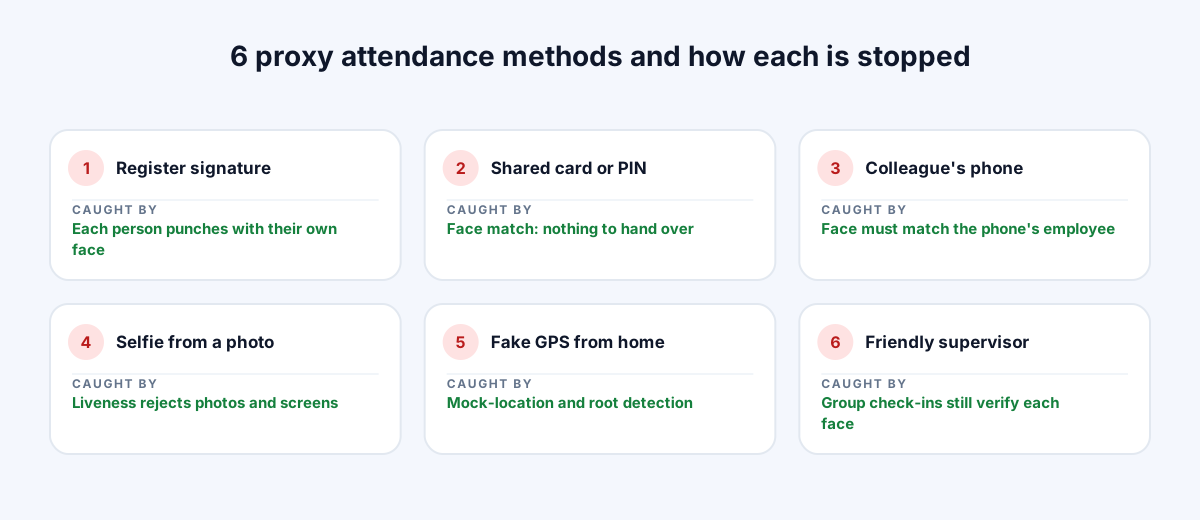
Proxy Methods vs. Geofenced Face Attendance
| How proxy works today | What stops it | |
|---|---|---|
| Register signature | How proxy works todaySomeone signs for the absent person | What stops itNo register: each person punches with their own face |
| Shared card or PIN | How proxy works todayThe card is handed over | What stops itFace match on every punch; nothing to hand over |
| Colleague's phone | How proxy works todayOne person punches for several | What stops itFace must match the phone's registered employee |
| Selfie from a photo | How proxy works todayPhoto of a photo passes | What stops itLiveness check rejects photos and screens |
| Fake GPS from home | How proxy works todayMock-location app fakes the site | What stops itMock-location and rooted devices detected and flagged |
| Friendly supervisor | How proxy works todaySupervisor marks the team present | What stops itGroup check-ins still verify each face, inside the geofence |
What about labourers without smartphones?
A supervisor can run a group check-in on their own phone inside the site geofence, where each worker's face is still matched individually. The supervisor provides the phone, not the attendance.
What Face and GPS Verification Can't Do
Verification proves who punched in and where. It doesn't prove what happened next. Someone can punch in honestly and leave an hour later, so pair attendance with location during shift hours and an alert when an on-duty employee leaves the geofence. Manual overrides are another gap: if a manager can mark someone present by hand, review those overrides as closely as you once reviewed the register.
Setup matters too. A geofence drawn far wider than the site accepts punches from the tea stall down the road, and a face enrolled in poor light causes false rejections that tempt supervisors back to manual entries. For how location-locked punching works in practice, see how a geofencing attendance system accepts punches only from inside the site.
Rolling It Out Without a Revolt
Practical steps
- 1Start with the site or team where proxy attendance is most suspected.
- 2Explain the reason: everyone is paid for the hours they actually work, and honest employees are no longer subsidising others.
- 3Enrol faces in one session, and have everyone do a practice punch inside the geofence.
- 4Run the old register in parallel for one week, then compare. The difference usually makes the case for you.
- 5Review flagged punches (spoofing attempts, failed face matches) weekly for the first month.
What to Do When You Catch It
Don't start with punishment.
The first flagged cases are usually a mix of genuine attempts and setup problems: a face registered in poor light, a geofence that's too tight for a basement. Check the record, talk to the person, and fix the setup where that's the cause.
Where it really is proxy attendance, handle it through your normal disciplinary policy and be consistent. The record does the work: a failed face match or a punch from a mock-location app is far easier to discuss than an accusation based on a surprise visit. Once people see that the system applies to everyone, including supervisors, attempts usually drop off quickly.
Bazat Tracker includes geofenced attendance, face verification with liveness, fake-GPS detection, group check-ins and payroll on every plan, from ₹249 per user per month on yearly billing.